
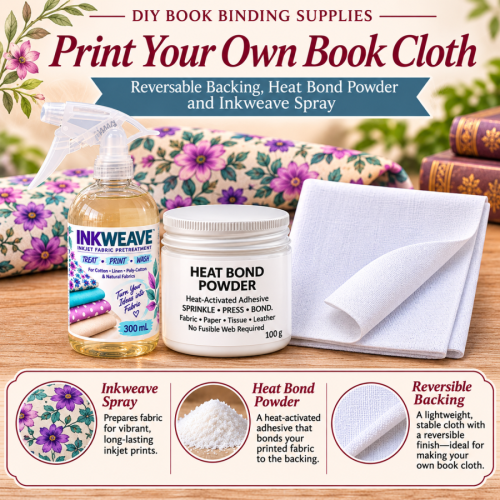
Print Your Own Bookcloth
Price range: R39.00 through R199.00
Print your own fabric and make it into bookcloth with InkWeave Spray, cotton backing and Heat Bond Powder. Fabric and a removable printing carrier are also available below. Pick the items you need and choose Spray on the InkWeave product page.
Print Your Own Bookcloth includes InkWeave fabric pretreatment, lightweight cotton bookcloth backing and Heat Bond Powder for making personalised printed book covers with your own suitable fabric.
- InkWeave™ Inkjet Fabric Pretreatment: use Select options and choose the Spray method on the retail product page.
- Reversible Bookcloth Backing – 100% Cotton 60gsm: lightweight cream cotton backing, approximately 70cm wide, sold per running metre.
- Heat Bond Powder – 100g: heat-activated adhesive for bonding compatible printed fabric and backing.
How the materials work together: Treat your suitable light-coloured cover fabric with InkWeave following its directions. Dry completely, attach securely to a suitable removable printing carrier and print using a compatible inkjet printer. Once the print is fully dry and any required finishing steps are complete, remove the printing carrier. Test a small piece, then bond the printed fabric to the bookcloth backing using a very light layer of Heat Bond Powder and its product directions.
Two different backings: The cotton bookcloth backing in this collection stays in your finished cover. It is not the removable carrier needed to feed fabric through a printer.
Available in the grouped list: Printable cotton fabric and a suitable removable printing carrier. An inkjet printer, ink, iron, pressing surface, protective pressing material, cutting tools, boards and board adhesive are also not included.
Choose each component and quantity separately. A quantity of 1 for the cotton backing means one running metre, approximately 100cm × 70cm. The 100g powder container is not a pre-measured dose for that metre. Test your fabric, ink and heat-bonding combination before completing your project. Heat Bond Powder adds a permanent bond; do not assume the finished laminate remains water-reversible.
Fabric and printer carrier
- 100% Cotton Bookbinding Fabric – 140gsm: choose a suitable light colour for printing. Treat it with InkWeave before printing, following the product instructions.
- InkWeave Reusable A4 Sticky Fabric Printing Backing: a removable carrier for feeding suitable A4 fabric through a compatible inkjet printer. Remove it after printing; it does not stay in the finished cover.
The cotton bookcloth backing is a separate layer that stays in the cover. Choose quantities separately and check each product size and application directions.
Choose your own items: Pick only what you need. Each item has its own price. Leave the quantity blank or at zero to skip an item. Use Select options to choose a size or colour.
Only logged in customers who have purchased this product may leave a review.
Frequently Asked Questions
How well do InkWeave prints withstand washing?
InkWeave-treated fabric has been tested through multiple washing-machine cycles followed by outdoor line drying, with encouraging colour retention. As with all printed fabrics, some fading and wear can occur over time, depending on the fabric, ink and washing conditions.
Does InkWeave work with dye-based and pigment-based inks?
InkWeave has been tested with HP Smart Tank 581 and Brother DCP-T310 printers, which use pigment-based black ink and dye-based colour inks when using original manufacturer inks. Both have produced encouraging results. Test unfamiliar printer and ink combinations first.
Should I use maximum DPI or maximum ink settings?
Not necessarily. More ink does not automatically produce longer-lasting colour. Fabric can only retain a certain amount of ink, and excess ink may wash away during the first wash. Good-quality settings, such as Matte Presentation Paper, can produce excellent results.
Is InkWeave flammable or does it smell?
InkWeave is a water-based fabric pretreatment. No noticeable odour has been observed during our testing, and it is not expected to present a flammability hazard during normal use. Avoid breathing spray mist and contact with the eyes. Wear gloves if you have sensitive skin.
Can InkWeave be used for baby quilts?
InkWeave is intended for quilting, sewing and fabric-printing projects. However, it has not been independently certified for baby products or prolonged contact with sensitive skin. We do not claim that it is baby-safe.
Can I apply InkWeave after printing?
No. InkWeave must be applied before printing. Spraying or soaking an already printed design will not produce the intended results.
Does InkWeave wash out of the fabric?
InkWeave helps the ink become fixed to the fabric. During washing, excess unfixed ink and some removable treatment residues may wash away. Complete removal of all treatment has not been independently verified.
Can I use my own fabric?
Yes. InkWeave Spray and Soak are designed to allow you to prepare your own suitable fabrics for home inkjet printing. Cotton and linen have given particularly good results. Always test unfamiliar fabrics first.
Will every inkjet printer and fabric give the same result?
No. Check that your printer can handle the combined fabric and carrier thickness, and use ink intended for your printer. Test a small sample first. This range is not for laser or dye-sublimation printers. Home inkjet printers do not print white: the original fabric colour affects the design. Light fabrics generally give clearer colours; test unfamiliar fabric colours and finishes.
How should I care for my printed fabric?
Allow the ink to dry thoroughly before handling or washing. Use gentle washing and handling, limit prolonged direct sunlight, and follow the instructions supplied with your product. Wash-test a small print before completing an important project. InkWeave is newly launched; we cannot guarantee a particular number of years.
Is the cotton bookcloth backing a printing carrier?
No. The cotton bookcloth backing stays in the finished cover; it is different from the removable carrier used to feed fabric through a printer. Printable cover fabric and a suitable removable printing carrier are purchased separately. Test the printed fabric, heat and bonding combination before completing your cover.
Printing Tips for Best Results
- Spray application: Spray InkWeave evenly over the fabric so the entire printing area is treated. Allow the treated fabric to dry completely before attaching it to a printing carrier.
- Soak application: Immerse the fabric in InkWeave Soak and allow sufficient treatment time. Soaking for up to 30 minutes has worked well in our testing. Dry completely before attaching the fabric to a printing carrier.
- Ironing treated fabric: If the fabric is still damp, cover it with a clean piece of fabric before ironing to help prevent brown marks. Use a temperature suitable for the fabric and make sure it is completely dry before printing.
- Treat before printing: Never apply InkWeave Spray or Soak after printing.
- Printer settings: Use a good-quality print setting, such as Matte Presentation Paper. Maximum DPI or ink saturation is unnecessary. Test your printer and ink combination on a small piece first.
- Backing preparation: If the reusable backing is excessively sticky, press clean, dry scrap fabric onto it and peel it off several times to reduce stickiness. It must still hold all edges firmly.
- Alternative printing carrier: Suitable kraft paper from a paper-ream wrapper, such as Mondi packaging, may also work as a printing backing. Test its grip, flatness and suitability for your printer first.
- Loose threads: Remove loose threads before printing because they can cause printer jams.
- Correct fabric size: For an A4 printing setup, use fabric that is A4 or slightly smaller, with no fabric overhanging the carrier. Overhanging edges can drag through the printer and cause permanent black marks.
- Flat fabric: Press dry fabric completely flat against the carrier, removing bubbles, wrinkles and loose edges to help prevent black smudges. Start by aligning one long edge, then smooth across to the other side.
- Printer protection and maintenance: Check the printer manufacturer’s supported media thickness, feed direction and paper path. Feed one secure sheet at a time. Keep the printer clean and carry out regular maintenance.
- Drying prints: After printing, allow the design to dry naturally or iron it dry using a suitable fabric temperature and a clean pressing cloth. Remove the reusable sticky carrier before ironing; do not iron its adhesive surface.
- Bookcloth finishing: Once the print is fully dry, remove the temporary printing carrier before bonding to the cotton bookcloth backing. Follow the Heat Bond Powder directions and test a small piece first. The finished laminate should not be assumed to remain water-reversible.
DIY Book Binding Supplies
Contact Us.
Email: info@diybookbindingsupplies.co.za
Address: 55 Dunville Road, Grosvenor, Bluff, Durban, South Africa, 4052
Sunday: Closed
Monday: 10:00am–17:00pm
Tuesday: 8:00am–17:00pm
Wednesday: 8:00am–17:00pm
Thursday: 8:00am–17:00pm
Friday: 8:00am–17:00pm
Saturday: Closed
“Made for bookbinders, artists, and lovers of handmade books.”
Reviews
There are no reviews yet.